ACE Test Accuracy & Reliability: What Science Says
When exploring your past, you need a tool you can trust. The Adverse Childhood Experiences (ACE) test is a powerful resource for understanding how early life events may shape your present. But a critical question often comes first: How accurate is the ACE test, really?
Knowing the science behind the score is key. Here, we’ll take an evidence-based look at the test's accuracy and reliability. We'll explore its scientific roots, its strengths, and its limits. Our goal is to give you the confidence to use this knowledge on your journey.
On our platform, we provide a confidential space based on this foundational research. It’s a secure first step toward gaining personal insight. When you are ready, you can begin your confidential test and receive immediate, clear results.

The Science Behind the ACE Test: Foundations & Validity
The credibility of any assessment starts with its scientific origins. The ACE test is not just a random quiz; it is rooted in extensive, landmark research that connects childhood experiences with adult health.
What is the ACE Test and Its Original Study?
The ACE test comes from a groundbreaking study in the 1990s. This large-scale investigation was conducted by the U.S. Centers for Disease Control and Prevention (CDC) and Kaiser Permanente. Researchers surveyed over 17,000 adults about their experiences before the age of 18.
This study identified ten specific types of adversity across three categories:
- Abuse: Physical, emotional, or sexual.
- Neglect: Physical or emotional.
- Household Dysfunction: Mental illness, substance abuse, domestic violence, divorce, or an incarcerated relative.
The test simply asks whether you experienced each of these ten events. Your ACE score is a straightforward count of how many of these experiences you report, ranging from 0 to 10. The study found a strong, graded relationship between the number of ACEs and a wide range of health problems in adulthood.

Assessing Clinical Utility: Does it Measure What it Claims?
In scientific terms, "validity" asks if a test measures what it’s supposed to measure. The ACE test has high validity for its intended purpose: identifying and quantifying exposure to specific types of childhood adversity. It accurately captures whether a person experienced the ten defined events.
Furthermore, its clinical utility lies in its predictive power. Decades of research back the original findings. A higher ACE score links to risks like heart disease, depression, or addiction. It flags issues early – great for personal insight or public health.
ACE Test Reliability: Consistency Across Time and Contexts
Beyond accuracy, a good assessment must be reliable. Reliability means the test produces consistent and stable results. If you take the test at different times, you should get a similar score, assuming your answers are honest and accurate.
Test-Retest Reliability: Are Scores Stable Over Time?
The ACE test demonstrates excellent test-retest reliability. This is because it asks about historical facts—events that happened in your childhood. These events do not change over time. Whether you take the test today or five years from now, the experiences you had before turning 18 remain the same.
While your memory or willingness to share might slightly shift, the underlying score is based on fixed events. This stability makes the ACE score a dependable measure of your past exposure to adversity. Your score provides a consistent baseline for understanding your personal history.
Consistency in Administration: Ensuring Standardized Results
One of the greatest strengths of the ACE questionnaire is its simplicity and standardization. When you take the online ACE test, you answer the same ten questions as everyone else. There is no variation in how the questions are asked or scored.
This standardized format removes variables that could otherwise influence results. It ensures that a score of 4 for one person means the same thing as a score of 4 for another in terms of exposure to the ten specified adversities. This consistency is crucial for both personal reflection and large-scale research, making the results comparable and trustworthy.
Understanding the Limitations of the ACE Questionnaire
To use the ACE test responsibly, we must be transparent about what it is—and what it is not. Acknowledging its limitations is key to interpreting your score in a healthy and empowering way. This honesty builds trust and ensures the tool is used for good.
The ACE Test as a Screening Tool, Not a Diagnostic Instrument
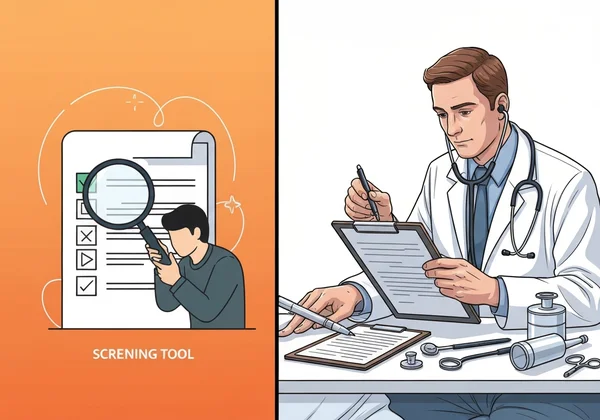
This is the most important distinction to understand. The ACE test is a screening tool, not a diagnostic instrument. It does not diagnose any medical or mental health condition like PTSD, depression, or anxiety. Instead, it identifies potential risk factors based on your past.
Think of it like a cholesterol screening. A high cholesterol level indicates a higher risk for heart disease, but it doesn't mean you will have a heart attack. Similarly, a high ACE score signals an increased risk for certain health challenges, but it does not determine your destiny. It is a starting point for awareness and conversation.
What the ACE Test Doesn't Measure (and Why That Matters)
The ACE questionnaire is intentionally focused on ten specific experiences. However, life is complex, and the test does not capture every form of adversity. Important stressors it does not measure include:
- Systemic racism and discrimination
- Community violence or poverty
- Bullying from peers
- The death or serious illness of a caregiver
It skips trauma details like how often or how bad it was. It also ignores positives – think a kind teacher or family support. Those build real resilience.
The Role of Context, Perception, and Individual Resilience
Your ACE score is a number, but you are not. It cannot measure your strength, your coping skills, or your capacity to heal. Two people with the same score? Totally different lives. Biology, relationships, and support make all the difference.
Resilience is the ability to adapt and thrive despite adversity. The human brain and body have a remarkable capacity for healing. Understanding your ACE score is not about dwelling on the past but about using that knowledge to build a healthier future. It can empower you to seek the right support and make choices that foster well-being. This is where your true start your journey of healing can begin.
Maximizing Insights: When to Seek Deeper Assessment
An ACE score is not an end point; it is a doorway to deeper understanding. Knowing your score can help you decide on the next steps, which may include seeking professional guidance for a more complete picture of your health.
When Your ACE Score Suggests Further Professional Consultation
If you receive your ACE score and feel distressed, overwhelmed, or simply curious to learn more, it may be a good time to speak with a professional. A therapist, counselor, or trusted doctor can help you put your score into context.
They can provide a safe space to explore how your past experiences may be affecting you today. A professional can help you develop coping strategies, address specific symptoms, and guide you on a path toward healing. Your score can be a valuable piece of information to share with them.

Integrating ACE Scores with Comprehensive Clinical Evaluation
For clinicians, therapists, and doctors, the ACE score is a powerful, yet simple, addition to a comprehensive evaluation. It can serve as a non-invasive way to open a conversation about trauma and its potential impact on a patient's health.
Used correctly, it helps create a more trauma-informed approach to care. A professional will never rely on an ACE score for a diagnosis. Instead, they integrate it with other clinical information. This includes a patient's current symptoms, strengths, and support systems to create a holistic and effective treatment plan.
Why Your ACE Score Matters – And What to Do Next
Your ACE score isn't just a number. It is a piece of information that can empower you to connect the dots between your past and your present. It's a launchpad to real change—confidential, science-backed, and ready when you are.
This score is not a label or a life sentence. It’s a starting point that can illuminate your path toward healing, resilience, and a richer, healthier life.
Ready to take the first step with a trusted tool? Take the free ACE test today to receive your confidential score and begin your journey.
Frequently Asked Questions About ACE Test Accuracy
Is the ACE test a scientifically validated tool?
Yes – straight from the CDC-Kaiser study that's shaped decades of research. The test is based on that landmark work, and years of follow-up studies have confirmed its validity. It accurately measures exposure to the ten specified adversities and links them to long-term health outcomes.
What are common misconceptions about ACE test results?
The biggest misconception is that a high ACE score determines your destiny. This is false. The score indicates risk, not certainty. Another is that a low score means you have no trauma; the test only covers ten specific experiences and doesn't capture all forms of adversity.
Can external factors influence the reliability of my ACE score?
Since the test asks about factual past events, the score itself is highly reliable. The primary factor that could influence your result is memory recall or an initial hesitation to answer with complete honesty. However, our secure test provides a private, non-judgmental space to encourage accurate reflection.
How should professionals interpret ACE scores given the test's limitations?
Professionals should use the ACE score as a conversation starter and a screening tool within a broader clinical assessment. It should never be used as a standalone diagnostic label. It is most effective when used to foster a trauma-informed perspective and to guide discussions about resilience and potential health risks.